Google Ads, driven by signals.
Your account is probably “fine.” Fine ROAS, fine agency, fine monthly PDF. The expensive problems in ad accounts are rarely visible from inside Google Ads - they live in the joins between your ads, your prices, your margins and what visitors do after the click. That's where we work.
This is not a menu item - it's where your Foundation report leads. When the monthly analysis shows spend fighting your own data and quantifies what it costs, we scope the fix as a fixed-price engagement - or hand precise inputs to whoever runs your account. It starts with DarkField Foundation.
Every visitor scored - spend follows measured intent
How ad accounts are usually run.
None of this is incompetence - it's what managing ads looks like when the only window is the ad platform itself.
Platform-only vision
The typical agency sees Google Ads and nothing else. Not your margins, not your price position against the market, not what visitors did on your site after the click. Every decision is made inside one tool's view of the world.
Last-click worship
Optimising toward the final click rewards campaigns that harvest demand and starves the ones that create it. It photographs well in a report - and it quietly caps your growth at whatever demand already exists.
Reporting theatre
Impressions, CTRs, a ROAS line going vaguely up - a restatement of what the platform already shows you. What's usually missing: what to change, what it's expected to earn, and an honest score of last month's advice.
Engagement signals lead the bidding
Every visitor is scored live on 49 behaviours that predict purchase - variant clicks, journey sequences, return patterns - with the weights learned from your own sales history, not an industry template. The scored tiers are exported into Google Ads as audiences: high scorers get bid up and seed lookalikes, cold traffic stops eating budget. Because the score moves days before a purchase does, your bids move before the platform's own conversion signal catches up.
POAS and LTV, not just ROAS
ROAS treats a 60%-margin sale and a 15%-margin sale as the same win. With your margin and repeat-purchase data joined into the journey, bidding can optimise for profit on ad spend and customer lifetime value instead: two products with identical ROAS get different bids when one earns triple the margin or brings buyers who come back. Selling leads instead of products? The same mechanics bid toward scored lead value.
Findings the tools can't see
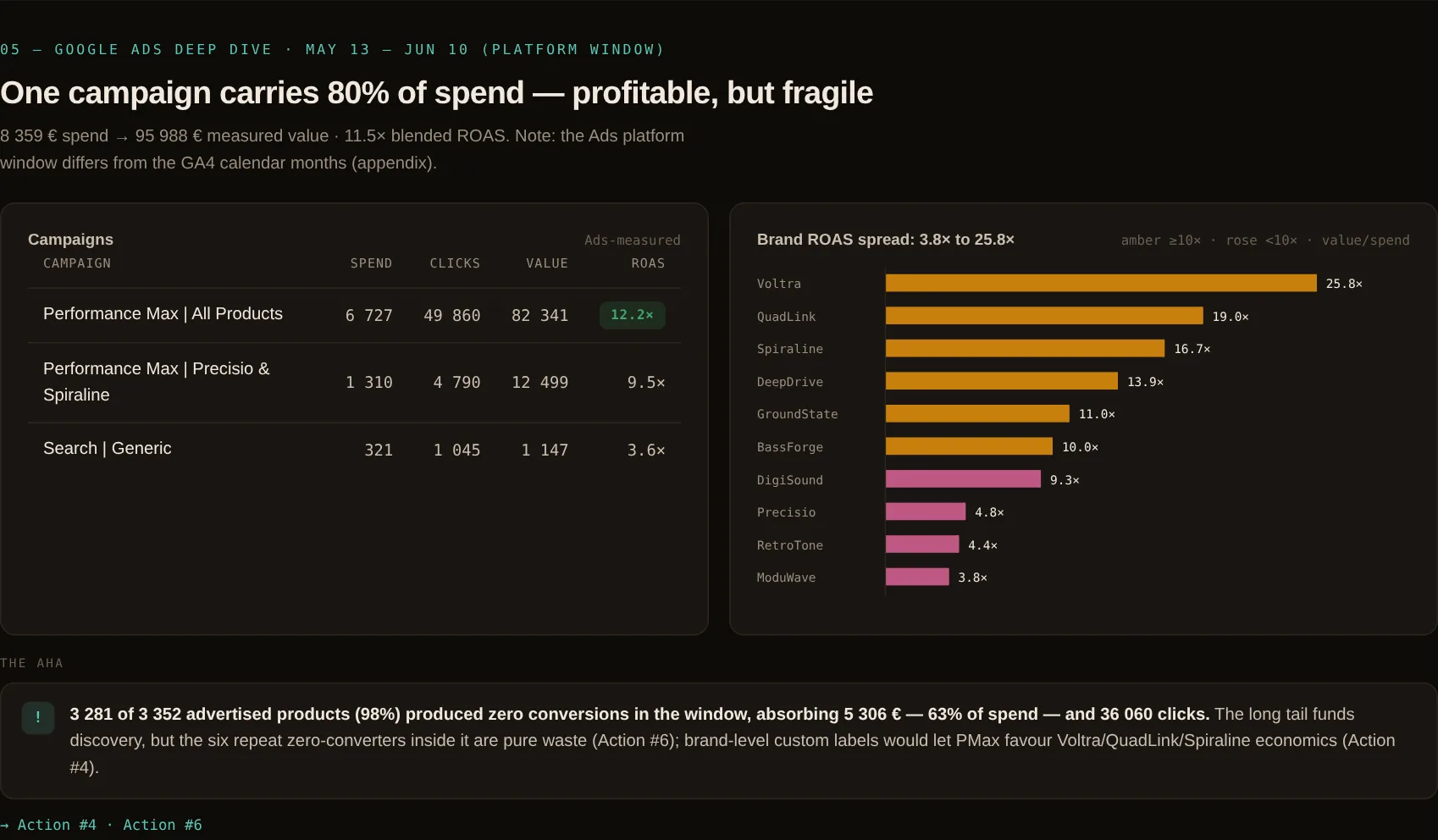
Because ads data sits in the same field as pricing, sales and analytics, the monthly analysis catches what platform-only management structurally cannot: budgets throttled during your best revenue hours, top-ROAS price bands starved of spend, products winning on price but invisible in ads, campaigns feeding on zero-converting long tails. In the sample report, one such join - price position × ad spend - surfaces a 20.8× band getting 14% of the budget.
Automated operations, human judgement
The routine work runs on automation so it actually happens every day, not when someone remembers: budget pacing and caps, search-term hygiene, bid adjustments, flagging products that absorb spend without ever converting. A human reviews what the automation proposes before anything structural ships. Consistency the manual agencies can't match - without paying agency hours for it.
What you actually get
- Your visitors scored and exported to Google Ads as bid-ready audiences - high intent, warming, cold
- Bidding strategy moved to POAS / LTV where your margin data allows it
- Feed custom labels (price position, margin band) so PMax steers itself toward what already wins
- Continuous account hygiene: pacing, caps, search terms, zero-converter product flags
- A Google Ads deep-dive in every monthly report - what changed, what it earned, and last month's calls scored honestly
Requires the foundation months first - pointing bids at dirty data is how accounts get worse with confidence.
20.8× ROAS, a fifth of the budget
The below-market price band earns the account's best ad returns on €527 of spend while the at-market band takes €2,692. The fix is a custom label in the feed.
The Foundation report
Ads management runs on the same unified field as your monthly analysis - every optimisation is measured in the next report, hit or miss.
You're probably wondering.
01We already have an agency - is this instead of them, or on top?
Either, honestly. With Foundation alone, the findings, scored audiences and feed labels go to whoever runs your account - many agencies do good work with better inputs. Or we scope the management as a custom engagement and run the account ourselves. The First Look is where we look at what you have and say which setup makes sense - including “keep your agency.”
02Isn't Performance Max a black box anyway?
Inside, yes - you'll never see its auction decisions. But you fully control what it eats: audience signals, feed data, exclusions. That's exactly where this service operates. The sample report's biggest ads finding is fixed with one custom label in the feed - no access to the black box required, just better food for it.
03What do you need from us to start?
Access - Google Ads, Merchant Center if you run one, and your sales or CRM data during the foundation build - plus meaningful spend for the signals to matter. If you're spending under roughly a thousand euros a month, we'll tell you on the First Look that this service isn't the right buy yet, and what to do instead.
Point spend at intent.
It starts with Foundation - the report finds what your ads account is missing and puts a number on it before you move a single krona of budget.